//
From Insight to Action: 5 Ways to Personalize Learning This Fall
Five practical ways to turn what you know about your students into meaningful next steps, without simply adding more to your plate.

Every teacher wants to meet students where they are. The challenge is doing that for every learner in the middle of a real school week.
So we asked two educators, Harl Roehm and Greg Bagby, to share what personalized learning looks like in practice. How do they take what they know about a student and turn it into something that actually helps? Kira’s Courtney Morgan led the conversation.
Their advice came back to five practical ideas teachers can bring into the new school year.
Step 1: Start by knowing your students, not testing them
Before a data point can tell you much, students have to feel known. Greg, who has been a teacher, district leader, and instructional coach, is blunt about the priority.
"I don't care what you do the first two weeks of school in the sense of academic. But I want you to get to know your students." — Greg Bagby
Harl, too, says that when students help set the classroom tone they ask for the same things: to be respected, valued, and heard. That trust is the foundation everything else is built on.
Plan a get-to-know-you activity that encourages real connection. Greg uses a Breakout EDU “break-in” box, where students solve clues about their classmates to open the locks.
Try simple icebreakers. Harl offers an example around food: Students write a few favorite foods on a card, then move around the room without speaking to form groups that can build a meal. Along the way, they debate the important questions, like whether each dish counts as a soup, salad, or sandwich.
Include your students in culture building. Let students help write the classroom rules, so the year starts with their buy-in, not just yours.
Step 2: Get your student data into one place
The honest starting point for most teachers is that the information exists, but it is scattered. Curriculum lives in one tool, grades in another, and assessment results often end up copied into a spreadsheet just to make sense of them.
Greg summed up the problem in one line:
"We have so much data, but we're implementation poor." — Greg Bagby
Individual teachers may not be able to connect every system, but there are ways to make the information they use more manageable.
Choose one school-approved place to look first. Choose a single place, even a well-built spreadsheet, where the data you act on lives: current skill or standard, most recent assessment, and any accommodations from a 504 or IEP. The goal isn't every data point. It's the handful you'd want in front of you before planning a lesson.
Keep the format consistent. Harl tracks students against specific objectives and uses a simple checkbox system for accommodations. Whatever format your school uses, consistency makes the information easier to understand and share.
Get your team speaking the same language.If every teacher describes student progress differently, that information becomes harder to carry from one classroom to the next. As a grade level or department, align on the skills, labels, and language you use.
Teachers should not be expected to solve disconnected systems on their own. When curriculum, assessment, and intervention are connected, teachers can spend less time assembling the picture and more time responding to what it shows.
Step 3: Use data to decide what comes next
A score tells you where a student landed. It does not automatically tell you what will help them move forward.
Greg described using de-identified student context with an approved AI tool to reshape a lesson around what his learners needed. He was careful not to include names or identifying information.
"Now with AI, you can grab not just quantitative but qualitative data ... and give you something that is personalized." — Greg Bagby
Start with one assessment. Look for the skills or standards students are still working toward.
Protect student privacy. Follow your school or district’s policies and remove identifying information before entering student context into an AI tool.
Use AI as a starting point. Ask an approved tool to suggest next steps, then use what you know about each student to decide what fits.
Keep the first step small. Begin with one class, one assessment, or one small group. Personalization does not have to mean reinventing your entire planning process.
Both educators acknowledged the same challenge: building this process prompt by prompt still takes time most teachers do not have. The tools should reduce that work, not create another system for teachers to manage.
Step 4: Personalize through connection, not more work
Personalization can quietly turn into assigning more: more remediation for students who are behind and more extension work for students who are ahead. But more work is not necessarily more personal.
Harl showed the difference through a simple story. He was creating a counting activity for a learner who was struggling. When she mentioned that she loved unicorns, he reshaped the activity around unicorns on the spot. She counted them, and she lit up.
"If I could take that and do that based off the kid's interest, now I'm not just assigning that extra work." — Harl Roehm
Start with what they care about. Connect an activity to a sport, character, animal, hobby, or topic the student loves.
Keep track of student interests. A simple list makes it easier to return to those details when someone needs a different way into the work.
Keep the goal, change the path. The academic goal can stay the same even when the way a student reaches it changes.
Make it a habit. Look for small opportunities to personalize across your classroom, so every student has a chance to feel known.
The goal is not to create a completely different lesson for every student every day. It is to use what you know about a learner when they need another way in. The personal detail tells them something important: you were listening.
Step 5: Build a shared view so students do not get missed
No teacher should have to carry this work alone. When educators use different systems and describe progress in different ways, it becomes much easier for students to fall between the gaps.
When teams share a clear view of where students are and what they need, the students who might otherwise be missed become easier to see.
That does not mean every teacher has to teach the same way. Greg was careful about preserving each teacher’s creativity and style while still working toward shared goals.
"We do need to be moving towards the same goal, the same destination ... Are we using a shared language?" — Greg Bagby
Review students together regularly. Set aside weekly or biweekly time to look at student needs as a team.
Talk about students, not just percentages. As Greg explained, “62% proficient” can hide the individual students who need support. A list of students and their next steps gives the team something it can act on.
Agree on the destination,not one teaching method. Align on what students are working toward and how progress is described, while leaving room for teachers to bring their own strengths and style.
Use a shared format. Harl admitted that his tracking can look completely different from the teacher next door’s. A common format helps teachers, coaches, and interventionists understand what a student needs without having to decode a new system every time.
This is how data stays connected to the human being behind it.
A final takeaway:
When teachers have the time and support to truly reach their students, the whole classroom changes. As Greg put it, “Joyful teachers will create joyful students.”
Asked to name one wish for the school year, both educators landed in the same place: that every teacher could authentically know every student.
Or, as Harl said:
“If the teachers know the kids, then doesn’t that essentially take care of everything else?”
Prefer to hear directly from educators? Watch the full conversation on demand.
See what this can look like with Kira
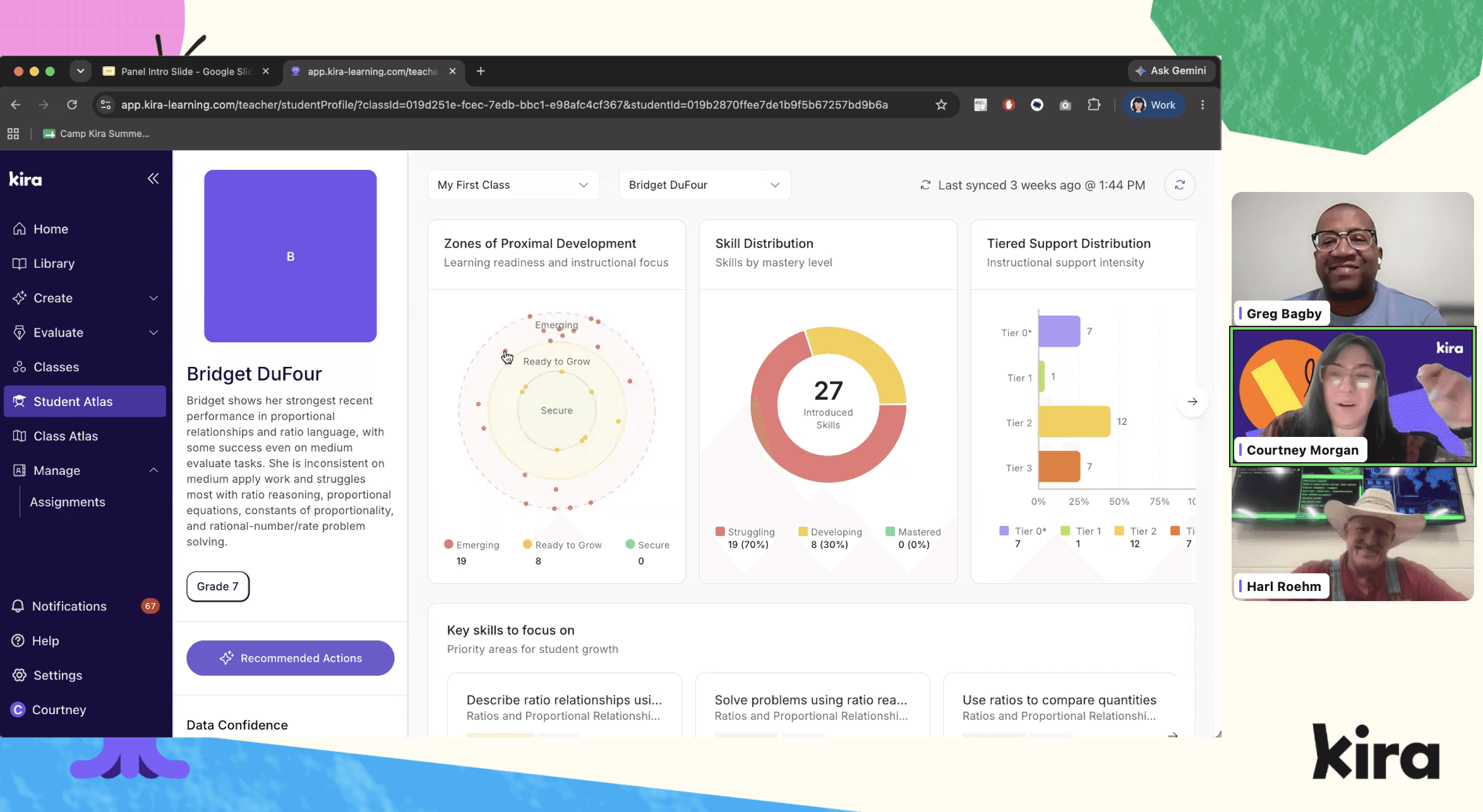
Personalized learning becomes far more practical when curriculum, assessment, and intervention work together as one. That is what Kira is built to do, and it is what turns these five steps from a heroic effort into something you can run every day.
In Kira, every piece of student work is connected to standards, and every standard is broken down into skills. Teachers can open the Student Atlas to see where each learner is, without manually piecing the information together across multiple systems.
From there, recommended actions help turn that picture into a next step. That might be a plan for what to work on next, a targeted lesson, or support for a student who was absent and needs to catch up.
It gives teachers a clearer picture of each student and more help deciding what to do next, without adding another layer of manual work.
To see how this could work in your classroom, and get in touch with Kira.
Share on:
