//
7 Cross-Curricular Activities for March Madness
These March Madness Kira classroom activities will bring brackets, probability, debates, and history to your students in engaging, cross-curricular ways.
Every March something happens that no textbook can replicate. Sixty-eight college basketball teams enter a single-elimination tournament that has the entire country filling out brackets, debating predictions, and arguing about upsets.
That same energy can work in your classroom.
These March Madness classroom activities bring the excitement of the tournament into middle and high school lessons across math, ELA, science, social studies, and history. Each activity is built around real academic skills such as probability, argumentative writing, data analysis, and historical reasoning.
The tournament bracket structure naturally pushes students to compare ideas, justify decisions, and defend their reasoning from different points of view, which mirrors the type of thinking students encounter in the real world.
Activity 1: Build Background Knowledge with a March Madness Reading Activity
Subject: ELA / Cross-Curricular
Activity Type: Read & Respond or Read & Chat
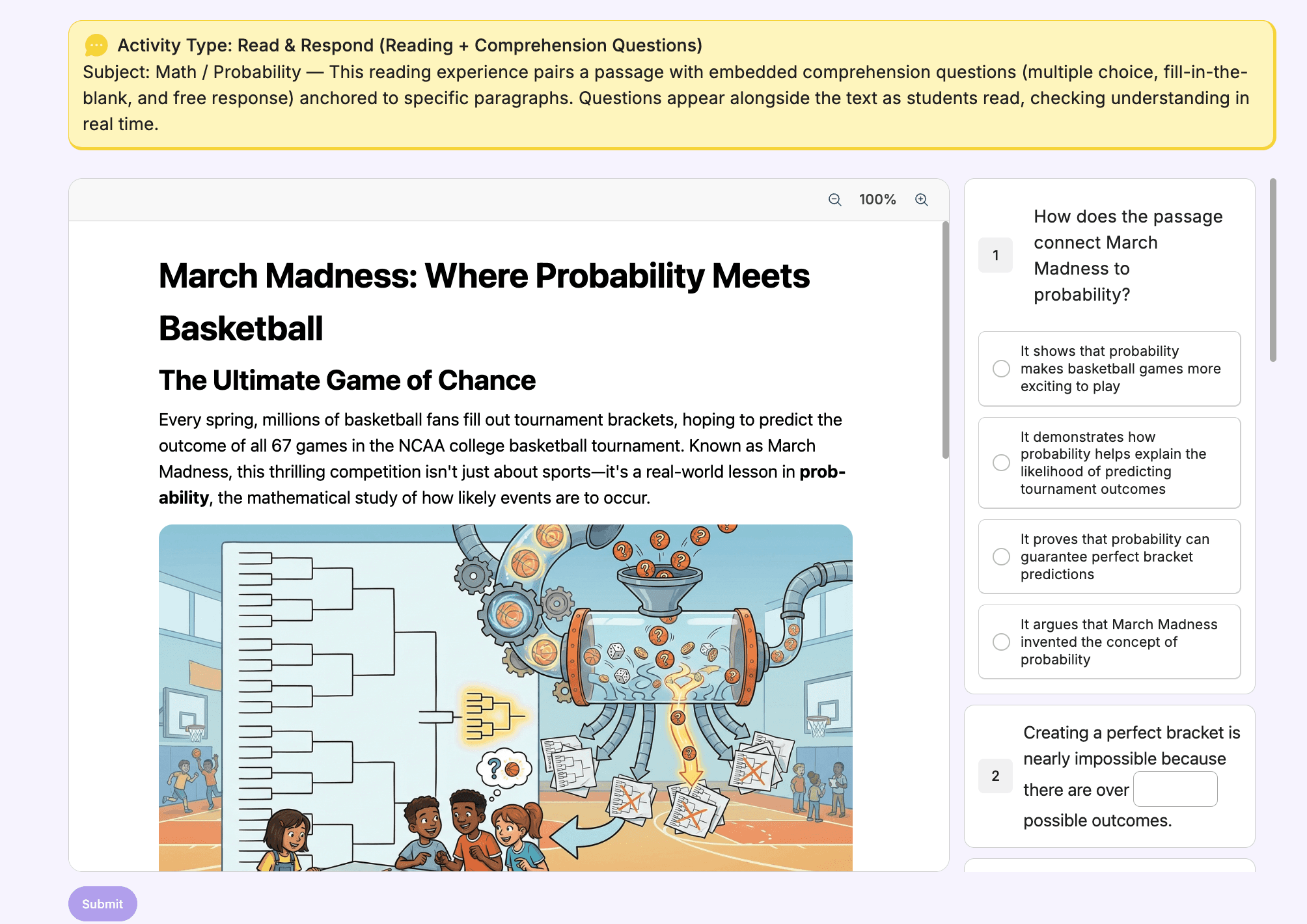
Start the unit with a short reading that introduces students to March Madness history and explains how the tournament works.
Students read about:
How brackets and seeding work
Why single-elimination tournaments create dramatic upsets
Famous Cinderella teams in tournament history
Interesting facts about March Madness, including how the tournament expanded to 68 teams
Teachers can embed multiple choice questions, short responses, or discussion prompts directly into the reading.
This works well as:
A warm up activity
Background knowledge before math or writing lessons
An independent reading assignment
Why this works: Students engage more deeply in later lessons when they understand the tournament narrative and the teams playing.
Activity 2: The Physics of a Basketball Shot
Subject: Science / Physics
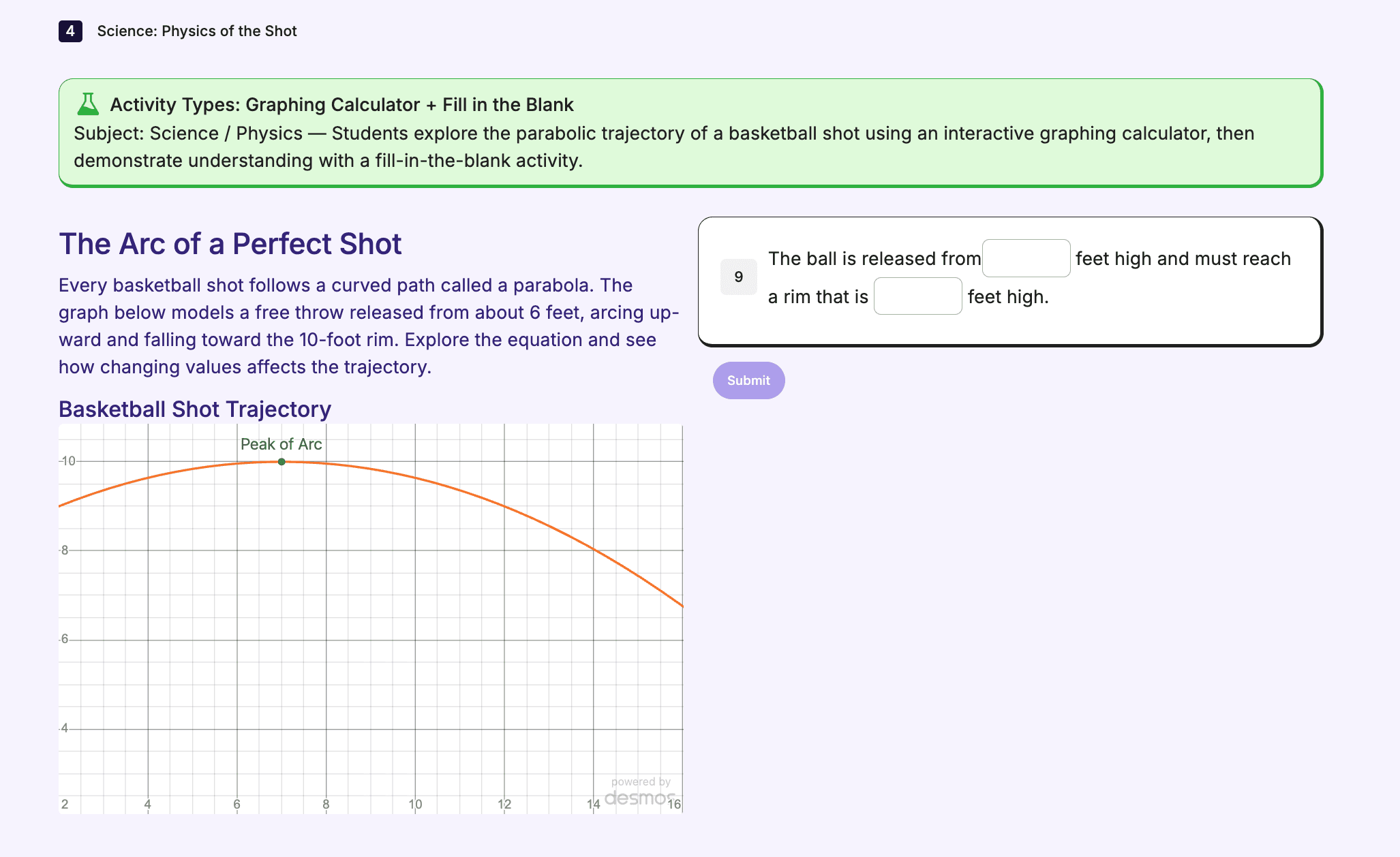
Activity Type: Graphing Calculator + Fill-in-the-Blank
Every basketball shot follows a parabolic trajectory.
Students use an interactive graph to explore how a shot travels from a player’s hands to the rim.
They investigate questions such as:
What release height is needed to reach the rim?
How does launch angle change the arc of the shot?
What happens when velocity changes?
Students then apply what they learn by filling in key values related to the shot trajectory.
Why this works: Projectile motion becomes concrete when students visualize it through a familiar sports moment involving a basketball team during a March Madness game.
Activity 3: A Timeline of March Madness History
Subject: Social Studies
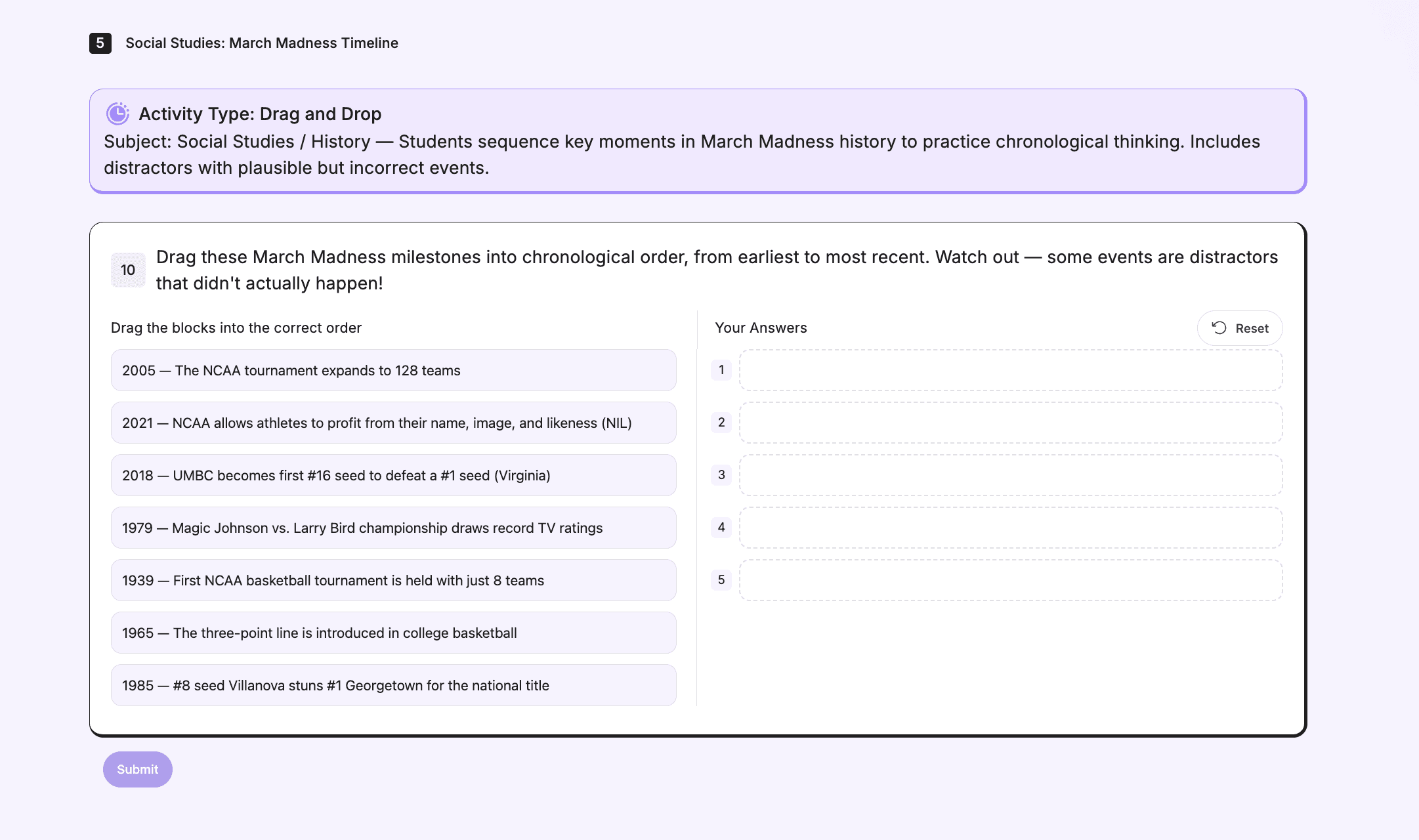
Activity Type: Drag-and-Drop Timeline
Students sequence major events in March Madness history, beginning with when March Madness started and continuing through modern tournament expansion.
Students analyze:
When the NCAA tournament expanded
How the Sweet Sixteen format became a cultural milestone
How the tournament compares to the National Invitation Tournament
Distractor events are included to challenge students to think critically rather than rely on guessing.
Why this works: Students practice chronological reasoning while seeing sports as part of broader cultural history.
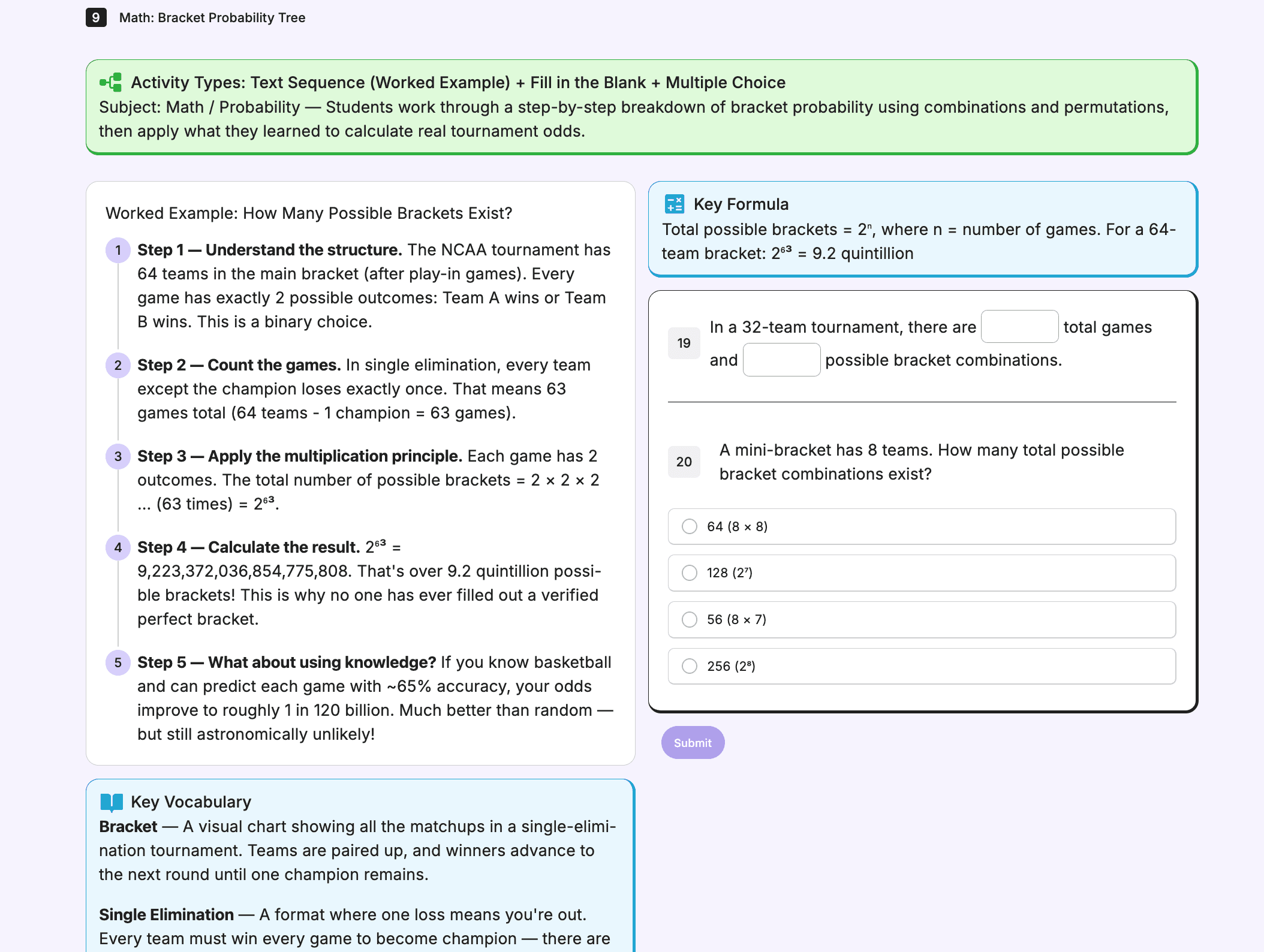
Activity 4: Probability and the Perfect Bracket
Subject: Math
Activity Type: Fill-in-the-Blank + Multiple Choice
One of the most famous facts about March Madness is how unlikely a perfect bracket actually is.
Students work step by step through the logic behind that probability.
They explore:
How many games exist in the NCAA tournament
Why each game represents two possible outcomes
How exponential growth explains the total number of bracket combinations
For a 64-team bracket students discover that the number of possible outcomes exceeds 9 quintillion combinations.
Activity 5: Persuasive Writing Through Tournament Debates
Subject: ELA / Argumentative Writing
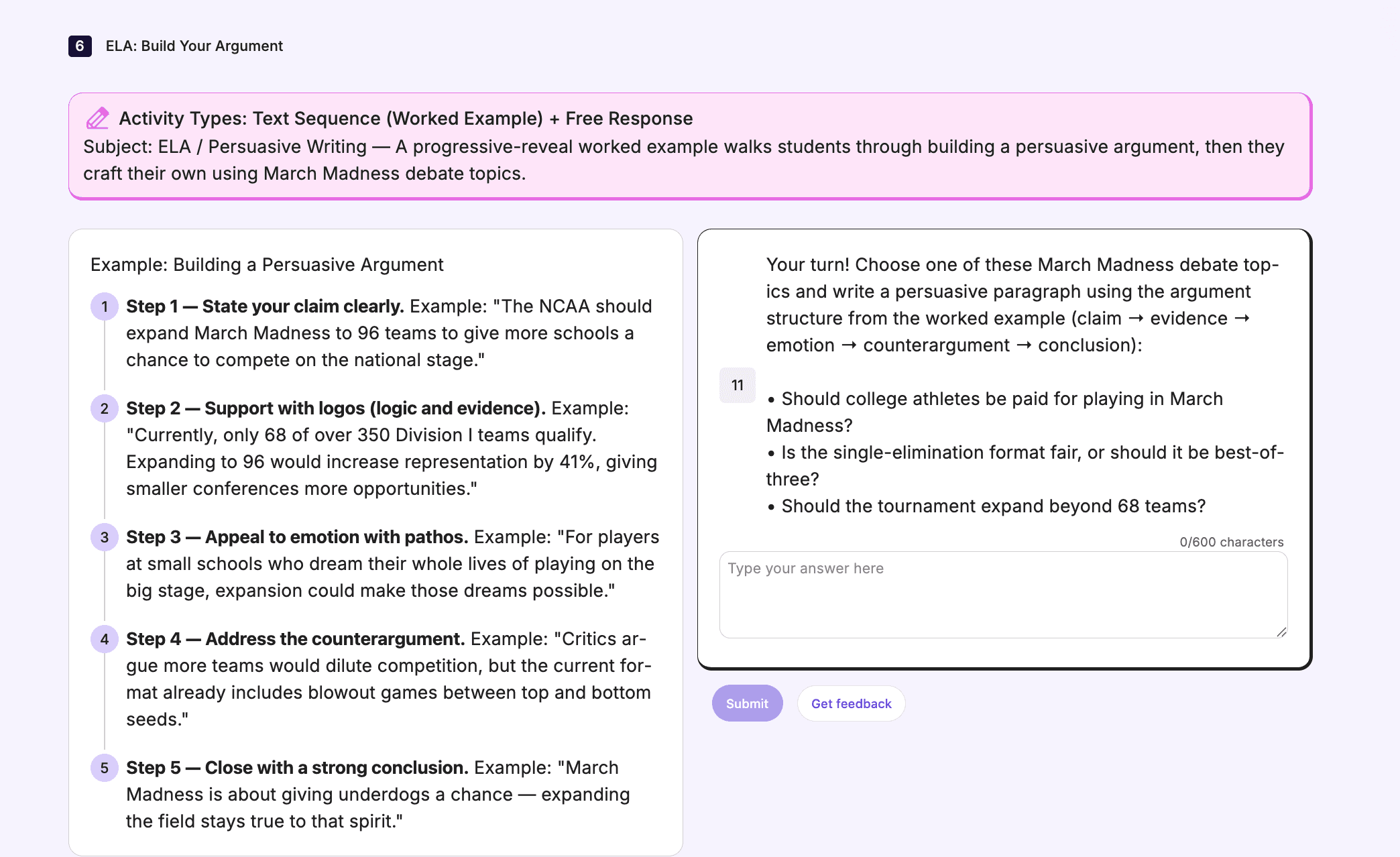
Activity Type: Worked Example + Free Response
March Madness raises questions students already have strong opinions about.
Students write arguments responding to prompts such as:
Should college athletes be paid?
Should the NCAA tournament expand beyond 68 teams?
Is a single elimination tournament the fairest format?
Students develop a thesis statement and support their argument with evidence and reasoning.
Why this works: Students who struggle with abstract prompts often engage quickly when the topic connects to sports, which makes this activity work well as a persuasive writing lesson.
Activity 6: Literary Character Brackets
Subject: ELA / Literary Analysis
Activity Type: Multiple Choice + Evidence-Based Writing
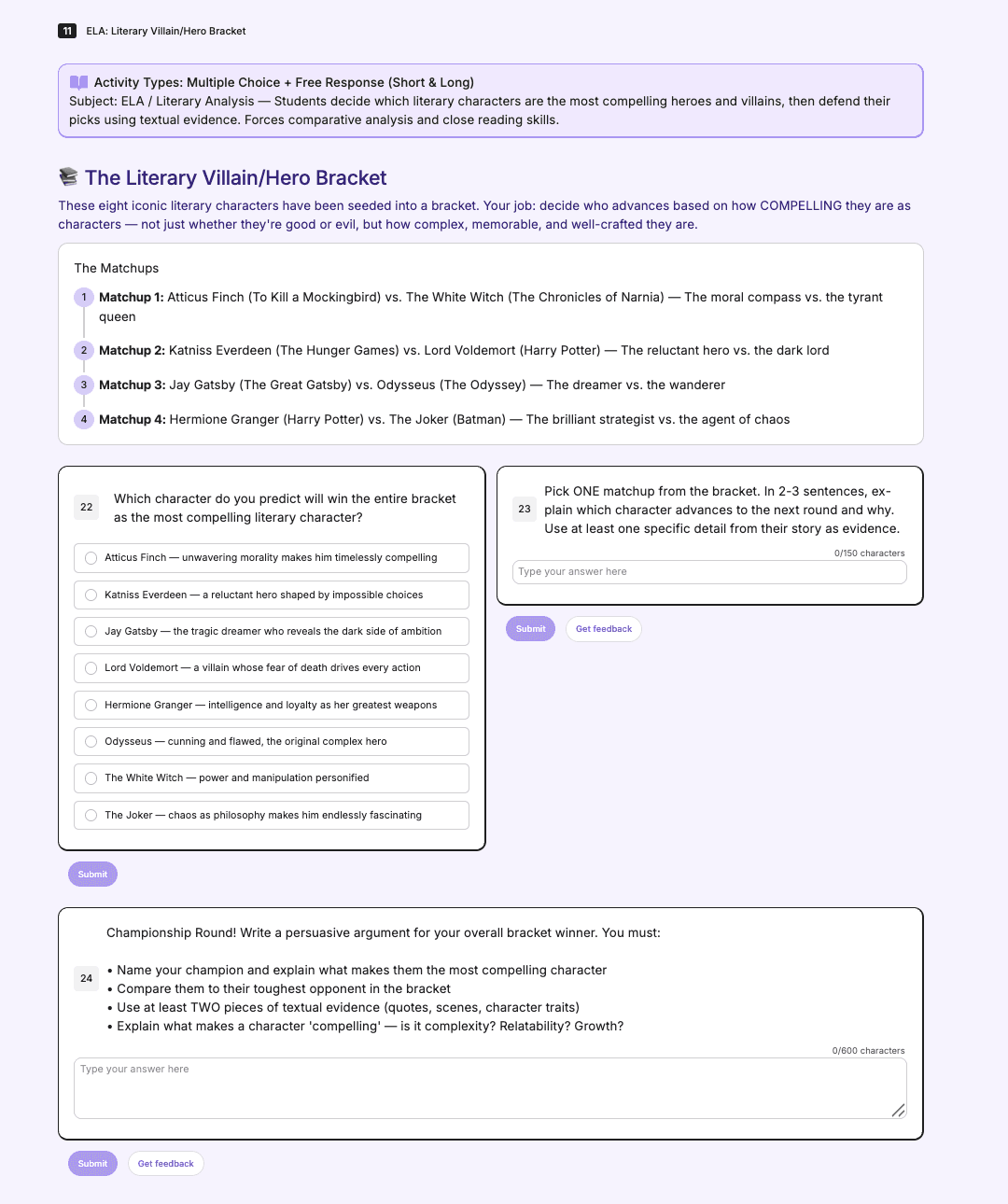
Instead of basketball teams, students build a character bracket and debate fictional matchups.
Example matchups might include:
Atticus Finch vs. The White Witch
Katniss Everdeen vs. Voldemort
Jay Gatsby vs. Odysseus
Teachers can structure the bracket so that even a 16 seed can challenge a top character, mirroring the unpredictability of a March Madness game.
Students analyze character motivations, themes, and development while defending their picks with textual evidence.
Why this works: The bracket format encourages comparative analysis and deeper literary interpretation.
Activity 7: The Greatest Historical Figure Bracket
Subject: History / Cross-Curricular
Activity Type: Essay + ChatPod
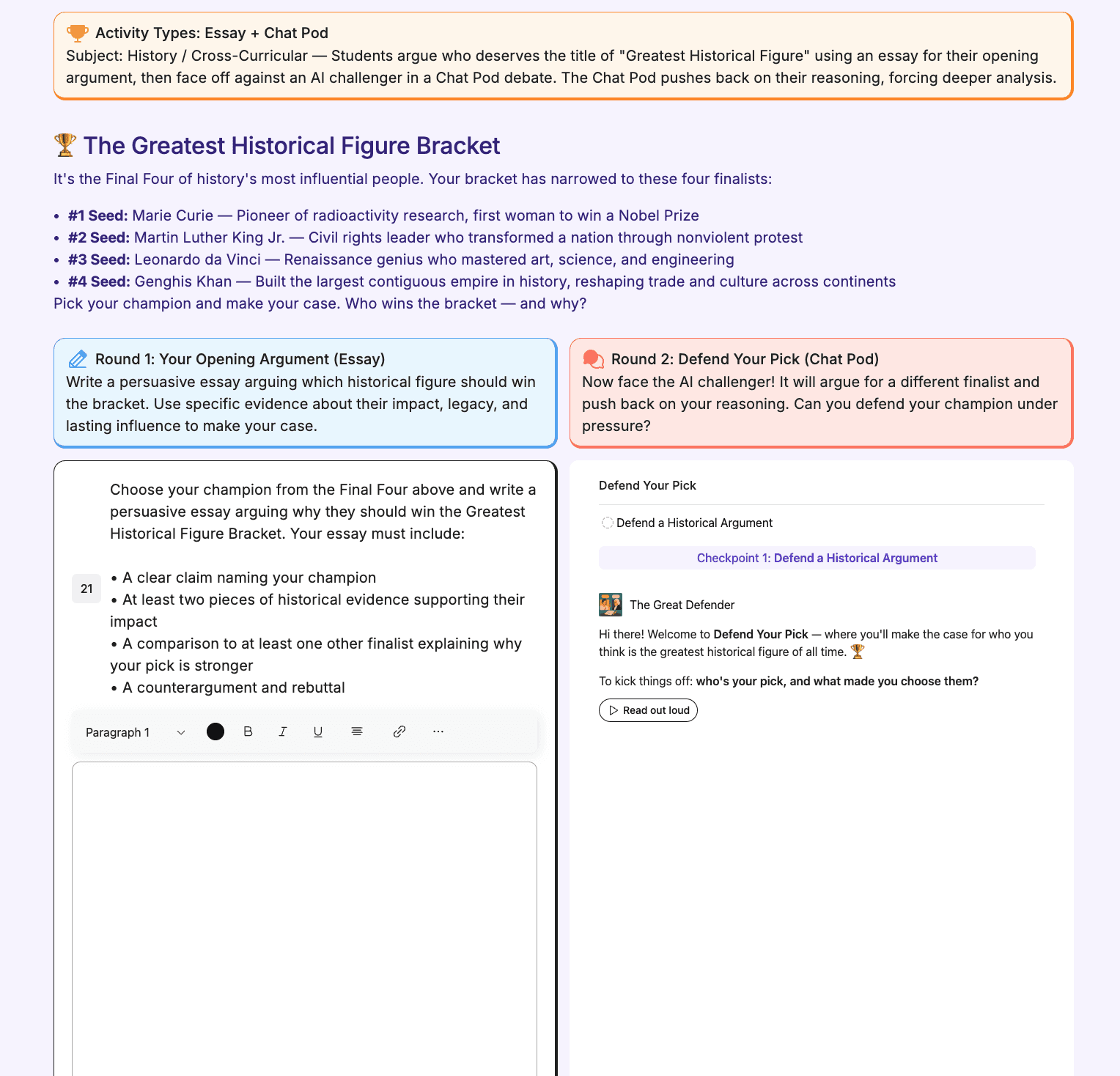
Students choose a champion from a Final Four of historical figures such as Marie Curie or Leonardo da Vinci.
Students research each figure’s influence, achievements, and historical impact before arguing for their champion.
Students then write an essay defending their choice using historical evidence and clear reasoning. During the activity they face a ChatPod challenger that pushes back on their argument and encourages them to defend their claims from multiple points of view.
Why this works: Students combine historical analysis with structured argumentation while experiencing the same competitive bracket format that defines March Madness activities.
Build These Lessons with Kira
You can access all these activities in this lesson here.
Once you create your account in Kira, you can add the lesson to your Resource Library and customize the activities for your classroom.
You can also start directly from your Kira homepage chat and generate your own March Madness classroom activities by prompting Kira to create reading passages, bracket debates, or writing assignments.
Share on:
