//
Turning Learning Gaps into Personalized Next Steps
How AI can help teachers turn learning data into differentiated instruction

Teachers know their students best—celebrating wins, deciphering blank stares, and tailoring support for every learner. Kira works alongside educators to quickly analyze student responses and generate targeted follow-up practice, helping keep learning insights and instruction aligned.
Recently, our Director of Learning Strategy, Courtney Morgan, spoke with educator Dr. Rachelle Dené Poth about how Kira can help teachers turn learning data into differentiated instruction and support every learner. Here are the main takeaways from their conversation:
Look closely at what your class needs next
Students working toward the same standard bring different strengths and learning needs. Seeing those differences across the class helps teachers decide where to focus instruction and how to support individual learners.
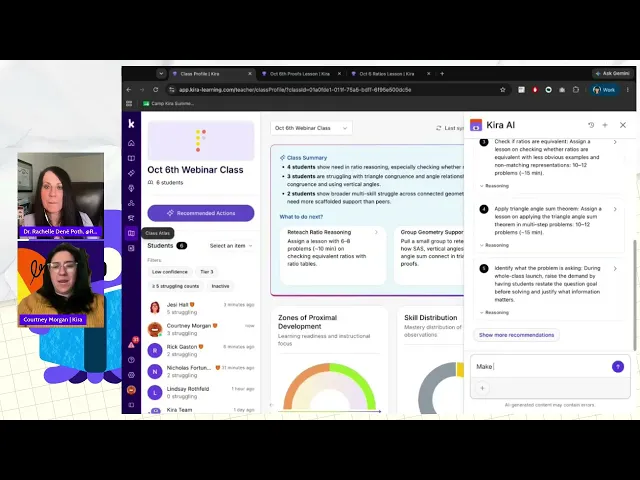
Class Atlas brings evidence from student work into one view, connecting performance to standards and their underlying skills. Teachers can explore patterns across the class while keeping individual progress in view.
That picture helps inform practical decisions: which concept to revisit together, who might benefit from small-group support, and which students are ready for a new challenge.

Turn learning insights into personalized practice
Knowing what a student needs becomes more useful when you can act on it.
Through Recommended Actions, teachers can use learning insights to plan support or create targeted lessons. They can also ask Kira to generate individualized practice across a class, with the learning focus, format, and available time in mind.
For example:
Create an interactive lesson for each student focused on their biggest area for growth. Aim for about 25 minutes of practice.
A follow-up lesson can draw on earlier responses, revisit incomplete reasoning, and provide worked examples alongside new opportunities to practice. Progressive reveal lets students move through an explanation one step at a time, using built-in progressive chunking for a better universal design for learning (UDL) experience by keeping subsequent steps blurred until the student is ready.
Give students support as they build understanding
Personalized practice also means helping students work through moments of uncertainty.
When enabled by the teacher, Kira’s AI Tutor is designed to guide students without giving away answers, gently redirecting off-task prompts and providing a safe environment to play and practice. ChatPods offer another way to practice through guided conversation, giving students space to explore their thinking before contributing to a classroom discussion.
These supports can sit alongside the individual conversations and small-group instruction teachers are already leading.
Let each round of learning inform the next
As students complete follow-up work tagged to standards in Kira, that performance feedback flows directly back into Student Atlas and Class Atlas. Teachers can revisit the learning picture, recognize progress, and decide what support would be useful next.
That might mean a new challenge, another opportunity to practice, or a conversation that helps a student explain their thinking. The next step can happen on the platform or in the classroom.
Start with one learning objective and one lesson. Let students’ work inform the next teaching decision, then keep building from there.
Inspired by a conversation with educator Rachelle Dené Poth and Courtney Morgan, Kira’s Director of Learning Strategy.
Watch the full conversation and see these examples in Kira →
Share on:
